
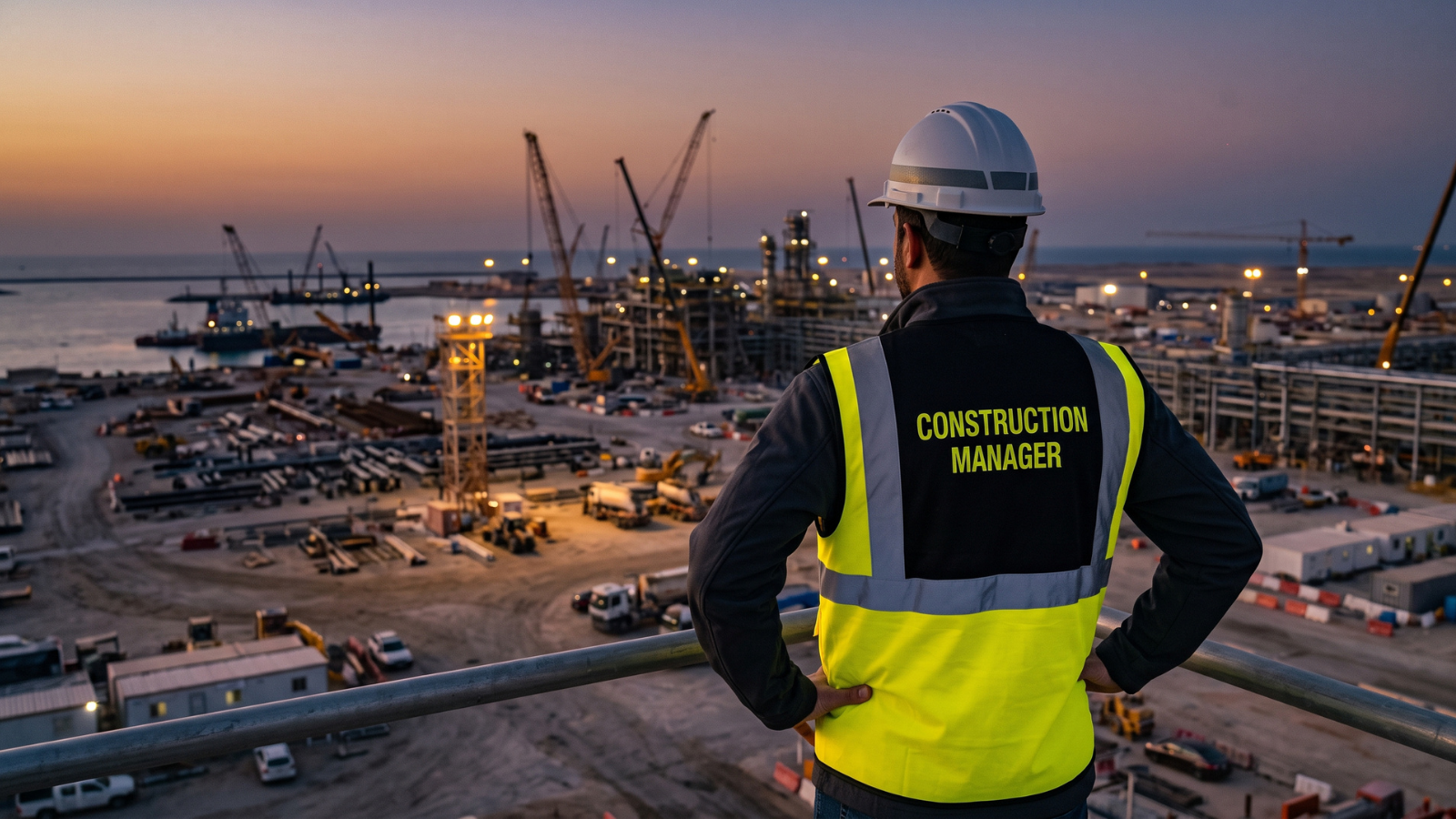
“On a mega project, the construction manager does not just build the plan. They defend it, daily, against everything that was not in it”
The day starts before the heat does. Across our Red Sea portfolio, 31 sites and some 900 people, a construction manager’s first job is not a meeting. It is a walk: which crew is short, which delivery missed the road, which pour must finish before the sun turns concrete unforgiving.
Months later the work looks different but feels the same. The walls are up, and the site fills with commissioning engineers, punch lists and inspectors from the Ministry of Interior, GACA, Civil Defense and MOMRA. HVAC, fire systems, ICT and a heliport’s aviation systems must all prove themselves before anyone signs a certificate.
Between the master plan and that final handover, one person has to make the plan survive the site. On a mega project, the construction manager does not just build the plan. They defend it, daily, against everything that was not in it. Nowhere is this clearer than in Saudi Arabia, where the pace of Vision 2030 has made delivery one of the most demanding in the world.
Bigger Projects, Bigger Problems
Bent Flyvbjerg’s research on megaprojects keeps finding the same thing: large projects usually run late and over budget, and the causes are mostly human. Optimistic plans, blurry accountability, late decisions. At this scale, one delayed package never stays contained; it pushes into the next trade until a two-week slip becomes two months.
In Saudi Arabia that effect is amplified. Many giga-projects are first of their kind, so there are no local productivity benchmarks, and deadlines are often tied to national milestones with little float. A good manager challenges unrealistic assumptions early, with data.
Drawings Don’t Pour Concrete
A design is not a construction plan. Someone must test it for sequence, access and safety before the first pour. Raising a problem early costs a conversation; raising it late costs a redesign. Some of the best gains come from asking the people who will use the asset. On a nursery expansion for Red Sea Global, working with the nursery team to replace weed mat with agricultural gravel cut a critical activity by 37.5%, and value-engineering the tree supports cut concrete volume by 40%.
Remote sites raise the stakes. Roads, power, water and camps must exist before real work begins, and summer heat cuts productivity and changes how concrete behaves. Logistics often decides as much as engineering.
Where Projects Really Break
Projects rarely fail inside a single contract. They fail at the seams: civil meets MEP, early works hand over to main works, the contractor’s programme meets the client’s plan for operating the asset. Owners, consultants, international designers and local contractors each bring their own habits, so the manager keeps them on one schedule and one set of facts.
Supply adds pressure. Giga-projects draw on the same labor, equipment and materials at once, and local-content requirements, valuable for the economy, add steps to sourcing and quality assurance. Ordering early and following up often is cheaper than any recovery plan.
Fast, Right, Safe: No Trade-offs
The pressure to go faster never lets up. Fast-tracking can save months, but only if inspections and testing are protected. Quality sacrificed for schedule is not recovered, only deferred with interest.
A site is a temporary city of many nationalities, and authority there comes from credibility: sound decisions, a visible presence, fair treatment of everyone. Skilled labor is scarce, and national policy rightly pushes for more Saudi talent, so the better managers build training and succession into the project rather than treating it as compliance.
Safety follows the same logic. On Saudi Aramco’s GOSP security upgrades, we planned partial plant shutdowns for medium-voltage cable and transformer work and completed them with zero safety incidents and no disruption to live operations. That came from planning, not luck.
What the Best Managers Do Differently
The strongest managers plan backward from handover, so commissioning and authority approvals are on the programme from month one. They report bad news early, because it never improves with age. They run on clear routines and honest data, not heroics, and they still walk the site. Dashboards tell you what happened; the site tells you why.
Handover Is the Real Finish Line
Completion is not the final pour. It is a tested, safe, documented asset, certified by the authorities and handed to an owner who can run it. In Saudi Arabia these projects will shape cities and daily life for decades, so the standard is higher than finishing on time.
The plan sets the direction. The construction manager makes it real.
Sources: Flyvbjerg, B. (2014). “What You Should Know About Megaprojects and Why: An Overview. Project Management Journal, 45(2), 6–19. | Flyvbjerg, B., & Gardner, D. (2023). How Big Things Get Done. Currency (Penguin Random House). ISBN 9780593239513. | Merrow, E. W. (2011). Industrial Megaprojects: Concepts, Strategies, and Practices for Success. Wiley. ISBN 9780470938829.

M. Abdur Rehman is a Senior Construction and Project Delivery Director with 16+ years of experience delivering multi-billion-riyal capital projects across Saudi Arabia for leading organizations, including Saudi Aramco, SABIC, the Royal Commission, and Red Sea Global.
A licensed engineer and PMP®️/PMI-RMP®️ certified professional, he specializes in strategic project delivery, multidisciplinary leadership, risk management, value engineering, and regulatory compliance, with a strong track record in successful project commissioning.